


| ||||||||||
| | | | | | | | | | |
Picos de Europa - El Cornion

Polish cavers coming to the western massif (El Cornion) of the Picos de Europa since 1978 were assigned for exploration by Parque Nacional de la Montana de Covadonga, through Federacion Asturiana de Espeleologia, an extensive area in the Asturian part of the massif. It includes the northern slopes of the Torre Santa Maria and Torre de los Traviesos and occupies an area of about 4.5 km2. The highest point in this zone is the summit of the Torre de los Traviesos with altitude 2390 m, and the lowest is the bottom of the cirque Joos de Reseco at about 1460 m. The beginning of the exploration in this part of the El Cornion may be accepted in 1961, when cavers from Grupo de Espeleologia Polifemo (GEP) made the first reconnaissance and confirmed the speleological attractiveness of the area. A year later Cueva de la Fragua was explored to the depth of 165 m. At the beginning of 1970s the area attracted the attention of French cavers from Speleo Club Orsay de Faculte (SCOF) who explored it systematically in years 1972-75.
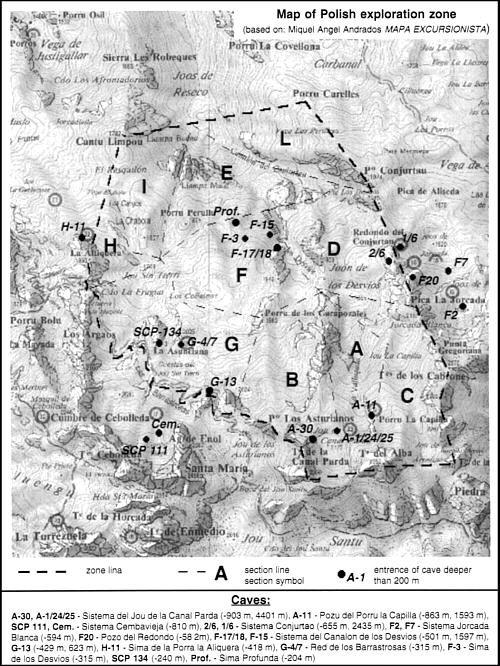
A team near F-17 cave entrance, ph. M. Chlipala A team near F-17 cave entrance, photo M. Chlipala Map of exploration area, click for bigger one Because of the large extent of the area their activity concentrated in the western and southwestern parts. The deepest caves explored then include:
Another cave discovered at that time was H-11 (beyond the present limit of the area), explored in 1972 to the depth of -73 m. Two years later, in 1974, members of GEP surpassed the depth of -350 m. In the same year cavers from Grupo de Montana Torreblanca (GMT) had discovered Sima de Cembavieja (Cem.) in an adjacent area, south of Barrastosas and near the limit of the zone; in it they attained -310 m in 1977. In total, the members of SCOF have discovered about 50 caves by then. At the same time they began to explore another area (Ozania), more promising as they believed, and abandoned their activity in this zone. 1978 The first Polish expedition was the reconnaissance by Speleoklub Warszawski (SW) in 1978, whose participants visited, among others, Red de los Barrastrosas (G-7/G-4) and Sima de los Desvios (F-3). They also prospected on the surface and marked about 30 new entrances. 1979 Since that year has began the regular activity of Speleoklub Gliwicki (SG), concentrated mainly in the part of the zone which had been little explored by SCOF. In 1979 the activity took place in the lower parts of the massif. Several caves were discovered, including Sima Profunda (-190), Sima de Nieve (-98) and Sima Cantolimpou (-76). Entrance series of Sima de los Desvios (F-3) were also searched in Sima de Cembavieja (Cem.) members of Seccion de Espeleologia Ingenieros Industriales (SEII) attain the depth of -350 m, while in Sima de la Porra la Altiquera (H-11) cavers from GEP reach -418 m. 1980 Exploration was continued in the caves discovered earlier. The results are the deepening of Sima de los Desvios from -280 to -315 m, Sima Profunda from -190 to 204 m and Sima Cantolimpou from 76 to -128 m. Also visited were Sima de la Torre de los Traviesos o de los Organos (A-1). Near the limit of the zone, on the side explored by the English, members of Oxford University Cave Club (OUCC) discovered Sima Conjuarto (1/6). Since 1981 for many years, because of the situation in the country, Polish teams were not coming to the Picos. Spaniards from SEII attained -550 m in Sima de Cembavieja (Cem.). This was the first so deep a cave in this part of the massif. 1982 In Sima de Cembavieja (Cem.) SEII and OUCC reach the final sump at the depth of -703 m. Members of OUCC descend to -520 in Pozu Jorcada Blanca (F2), which lies next to the limit of the Polish zone. 1983 The English reach the final sump in Pozu Jorcada Blanca (F2) at the depth of -594 m. 1984 After a long break Poles reappear in the Picos. Their penetration into Sima de la Torre de los Traviesos o de los Oroganos, started in 1980, ends at the level attained by the French (-416).
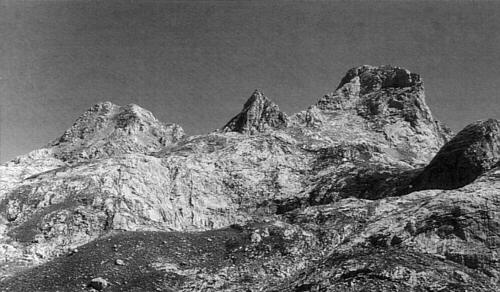
During the same expedition began the exploration of the virtually unknown southeastern part of the area, resulting in more than 40 new caves (including A-30), mostly shallow ones. Only A-11 (Pozu del Porru la Capilla) offers some prospects. Its exploration ended with an accident at the depth of ca. 120 m. During a violent rise in waterflow Piotr Kolodziej died. After the rescue operation, the members of the expedition decided to postpone exploration and come back to Poland. The cave was explored to about -180 m. In the same year members of Speleo Club de la Universidad Politecnica de Valencia (SCP) discovered Sima Parodia (SCP) and attained in it the depth of ca. -38 m. Cavers from OUCC made a connection Peaks surrounding Jou de la Canal Parda, ph. R. Pasiok Peaks surrounding Jou de la Canal Parda, photo by R. Pasiok of Pozu los Perdices (F7) with Pozu Jorcada Blanca (F2), resulting in the Sistema Jorcada Blanca (F2/F7). 1985 The drama of the former expedition dissuaded members of SG from the next expedition to the Picos.
Meanwhile, members of SCP made the connection between Sima Parodia (SCP 111 ) and Sima de Cembavieja (Cem.), which results in a system of a total depth of 810 m. They also attain -157 m in SCP 134. Cavers from OUCC attain -452 in Sima Conjuarto (1/6). They also explore Pozu del Redondo (F-20) down to -382 m and 2/6 to -80 m. 1986 Continues the exploration of Pozu del Porru la Capilla (A-11 ), undertaken by Sekcja Taternictwa Jaskiniowego Czestochowa (STJC). At the depth of -400 it becomes clear that this may be another deep cave in this part of the Picos. Another Polish expedition, from Katowicki Klub Speleologiczny (KKS), acting together with the members of SCP attains, among others, the depth of -240 m in SCP 134. In the British zone, cavers from OUCC connect 2/6 with Sistema Conjuarto, resulting in Sistema Conjuarto, where they attain -655. In Pozu del Redondo (E20) they attain -582 m. 1987 Several years of exploration in Pozu del Porru La Capilla (A-11) finally brings about the long expected results. This time the success belongs to an SG expedition. They reach the final sump at -863 m. 1988 The next expedition by SG is a systematic search for new, high entrances. About one hundred new entrances were located, even in the apparently well searched zone G (among others G-13).
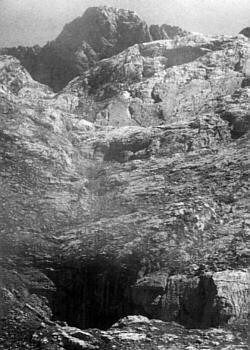
The entrance to G-8 Cave, ph. R. Pasiok The entrance to G-8 Cave, ph. R. Pasiok At the same time exploration in Red de los Barrastrosas was undertaken, showing possible leads. 1989 The rosy exploration prospects drew two expeditions from Poland: an SG expedition aiming at further exploration in zone A and an expedition of Sekcja Grotolazow Klubu Wysokogorskiego Wroclaw (SG KWW), intending to work in zone G. The small SG expedition explores A-30 to the depth of -245 m. At the same time the big expedition of SG KWW searches zone G. They mark ten new caves of small depth, visit most known caves in the zone and confirm the open possibility of advance in Red de los Barrastrosas. The main achievement was the exploration of G-13 down to 429 m. The farther activity was arrested by the accident of Wieslaw Smigielski.

After a fall of fourteen meters in G-13 he had a broken rib and injured spine. A five days rescue operation terminates the work of the expedition. 1991 The regular exploration activity of SG members is continued by expeditions of Speleoclub Wroclaw (SCW). A reconnaissance expedition concentrates in A-30 and it results in the extension of this cave from -245 to -552 m. 1993 The next SCW expedition continues exploration of A-30, which after the 1991 expedition was named Pozu del Picu de los Asturianos. A surface search resulted in marking several new entrances.

1994 The main goal of the SCW expedition was exploration of Pozu del Picu de los Asturianos (A-30), where they achieved -726 m. Surface prospection was continued in Jou Arenizas (C) and Canalon de Los Desvios. The former did not bring a single cave deeper than 50 m, while in the latter F-17 proved to be the entrance to a cave 477 m deep. After a subsequent connection with a higher entrance (F-18) Sistema del Canalon de Los Desvios (F-17/F-18) became 501 m deep. Also found was the entrance to F-15. 1995 Exploration of Pozu del Picu de los Asturianos (A-30) was continued parallel with the exploration of Sima de los Traviesos o de los Organos (A-1), resulting in their communication and establishing a new interesting cave system - Sistema del Jou de la Canal Parda (A-1/A-30). As usual Jou de Arenizas (C) was searched and as usual several new shallow caves were found (for instance C-7, about -70 m). Activity in Canalon de Los Desvios was also continued. Exploration in F-15 resulted in its connection with the known parts of Sistema del Canalon de Los Desvios (F18/F-17), largely extending the system.
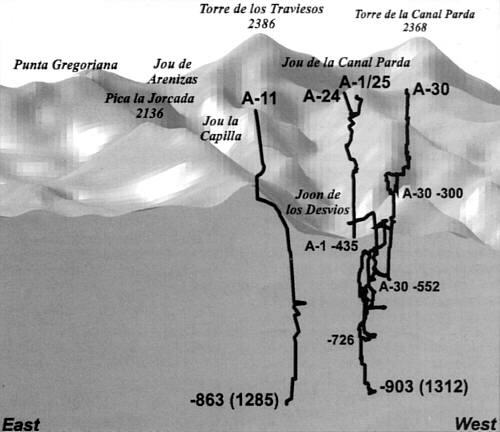
1996 Sistema del Jou de la Canal Parda (A-1 /A-30) was deepened down to 903 m. Prospection was done for higher entrances to this system and to Pozu del Porru la Capilla (A-11). Section NS Section EW Sections of explored caves Sima de los Desvios (F-3) was searched with a view of connecting it with Sistema del Canalon de Los Desvios (F-15/F-17/F-18). The activity of the Polish groups in the western massif (El Cornion) of the Picos de Europa since 1978, though irregular, brought about some results, especially in zone A. There were in all fifteen Polish expeditions organized by the following clubs: Speleoklub Warszawa (1978), Speleoklub Gliwice (1979, 80, 84, 87, 88, 89), Sekcja Taternictwa Jaskiniowego Czestochowa (1986), Katowicki Klub Speleologiczny (1986), Sekcja Grototazow Klubu Wysokogorskiego Wroclaw (1989) and Speleoclub Wroclaw (1991, 93, 94, 95, 96). The history of exploration, presented above, was reconstructed on the basis of so rich a material that it can not be listed here. Many facts in this material were contradictory. Special thanks go to our friends Armando Alonso Bernardo Fernandez and Juan Jose Gonzalez Suarez from Federacion Asturiana de Espeleologia and all those Spaniards thanks to whom the expeditions to the Picos will remain our best memories.
Marek (Stahoo) Jędrzejczak
cały artykuł do ściągnięcia w wersji PDF jest dostepny tutaj: The Caves 1997 (PDF: 1,9MB)